
Can You Install a Custom Gate on a Sloped Driveway?
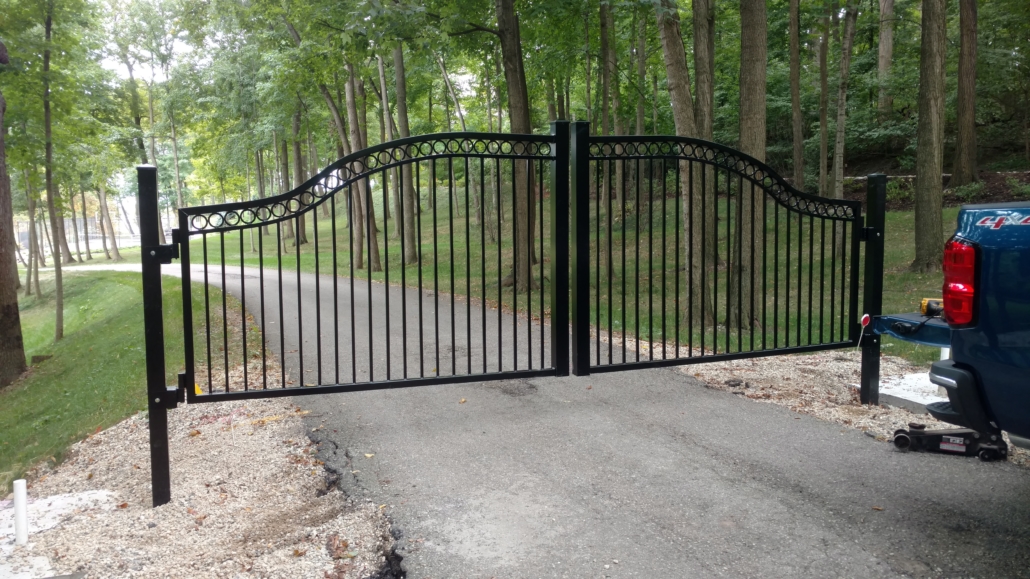
Yes, you can install a custom gate on a sloped driveway. The important part is designing the gate around the actual grade of the driveway rather than treating the opening like level ground.
A slope changes how much clearance the gate has as it opens, where the hinges can sit, and which direction the gate can travel. A layout that works well on a flat driveway may drag against the pavement or lose clearance on an incline.
At R.C. Portable Welding & Fabrication, we start with an on-site review and measurements before fabricating a driveway gate. That gives us the information needed to build around the width, grade, available space, and intended use of the entrance.
How Does a Sloped Driveway Change Custom Gate Design?
A swinging gate travels through an arc. If the driveway rises in the same direction as the swing, the bottom of the gate gets closer to the pavement as it opens. On a steeper driveway, it may hit the ground before reaching its full open position.
A driveway can also slope from one side of the entrance to the other. In that situation, one end of the gate may sit much closer to the ground than the other. Raising the entire gate may create enough clearance, but it can also leave a larger gap under the downhill side.
This is why the grade needs to be measured along with the width of the opening. The gate needs to fit when closed and have enough room to travel through its full range of motion.
RC fabricates metal gates for driveway entrances and other residential, commercial, and industrial applications.
Which Gate Style Works Best on an Incline?
There is no single driveway gate design that works for every slope. The direction and severity of the grade, available space, and desired opening all affect the best configuration.
Changing the Swing Direction
If the pavement rises sharply on one side of the gate but falls or remains more level on the other, changing the swing direction may solve part of the clearance problem.
The gate still needs enough space to open without interfering with parked vehicles, buildings, fencing, landscaping, or normal traffic through the entrance.
This is one reason it helps to look beyond the opening itself. The area where the gate moves can be just as important as the space it covers when closed.
Increasing Ground Clearance
A modest incline may allow for a conventional swing gate with additional space between the bottom rail and the driveway.
The amount of clearance should be planned carefully. Too little can cause the gate to catch on pavement, gravel, or winter buildup. Too much may leave a larger opening underneath than the property owner wants.
Instead of automatically raising a gate several inches, it makes more sense to measure how much clearance is actually needed through the entire swing.
Building Around a Cross Slope
Some driveways are relatively level in the direction vehicles travel but slope noticeably from left to right.
A fabricated gate can account for that difference in elevation so the closed gate fits the entrance more naturally. The hinge placement, frame dimensions, and bottom edge can all be considered during fabrication rather than trying to compensate during installation.
That is where custom fabrication becomes especially useful. RC can build metal components around the project’s dimensions through its broader fabrication services.
Considering a Sliding Configuration
A sliding gate can sometimes be useful when a swinging gate would have difficulty clearing rising pavement.
Instead of sweeping across the driveway, the gate moves laterally beside the entrance. This removes some of the clearance issues caused by an uphill swing, although the property needs enough usable space beside the driveway for the gate to travel.
A sliding gate is not automatically the better option. The surrounding grade, available side room, gate size, and support system still need to be considered before settling on the design.
Why Accurate Measurements Matter More on a Sloped Driveway
Measuring only the distance between two gate posts is not enough when the driveway is uneven.
The grade should be evaluated across the opening and through the area where the gate will move. Nearby pavement edges, fences, buildings, landscaping, and other site conditions can affect the available clearance.
Longer gates make those measurements particularly important. Even a gradual change in elevation can become noticeable across a wide driveway opening.
R.C. Portable Welding & Fabrication begins its gate projects with an on-site review and measurements before developing the project quote. Fabrication is completed in-house, followed by installation. That process allows the dimensions of the actual entrance to guide the build instead of relying on a standard gate size.
What About Snow, Ice, and Wisconsin Driveways?
A gate that clears the pavement in summer still needs enough room to function during a Southern Wisconsin winter.
Snow and ice can temporarily reduce the space underneath a driveway gate. Gravel entrances can also develop uneven areas over time, while pavement transitions and drainage patterns may create high points within the gate’s travel path.
This does not mean every gate needs a large gap underneath it. It means seasonal conditions should be part of the clearance discussion before fabrication begins.
For properties around Elkhorn, Lake Geneva, Delavan, Whitewater, Burlington, and nearby communities, thinking about winter clearance during the design stage can prevent an otherwise well-built gate from becoming difficult to operate when conditions change.
Can You Automate a Gate on a Sloped Driveway?
A sloped driveway does not automatically rule out an automated gate, but the gate first needs to move properly through its full opening.
Gate weight, hinge geometry, slope, opening direction, and available clearance can all influence an automated system. Those details are easier to address during the initial design than after a gate has already been fabricated.
Automatic vehicular gates also have specific operator and entrapment-protection requirements. UL 325 is the primary safety standard covering automatic gate operators and related systems, including swing and slide gate operators. Property owners planning an automated entrance can review the UL 325 standard when evaluating operator requirements.
If future automation is part of the plan, bring it up early. A gate designed only around manual operation may need different considerations than one intended to work with an operator later.
When Does a Sloped Driveway Need a Fully Custom Solution?
The more the grade changes across the opening, the less useful a one-size-fits-all gate becomes.
A custom solution becomes especially valuable when the driveway rises through the gate’s swing, slopes heavily from side to side, has limited room around the entrance, or needs to work around existing posts, fencing, or structures.
Those conditions do not necessarily make the project unusually complicated. They simply mean the gate needs to be designed for that specific entrance.
For commercial and industrial properties, the same principle applies. Gate dimensions and movement should reflect how vehicles use the entrance and how much operating space is available rather than starting with a standard product and working backward.
Plan Your Custom Gate Around the Driveway
A custom gate can work on a sloped driveway when the grade is considered before fabrication begins. The most practical design may involve changing the swing direction, adjusting ground clearance, accounting for a cross slope, or choosing a different gate configuration.
R.C. Portable Welding & Fabrication handles custom metal gate projects from the initial site review through fabrication and installation. Working from the actual measurements of the entrance makes it possible to account for conditions that a standard gate may not handle well.
If you have a sloped driveway in Southern Wisconsin or Northern Illinois and want to discuss what will work for the space, request a quote from R.C. Portable Welding & Fabrication.

Leave a Reply
Want to join the discussion?Feel free to contribute!